Exchange-of-winnings game at Hautdesert
Sir Gawain and the Green KnightThe Exchange-of-winnings game at Hautdesert turns hospitality into a test of reciprocal obligation. Sir Gawain agrees that whatever Bertilak wins in the woods will belong to Gawain, and whatever Gawain obtains will be exchanged in return. The hunt gives this compact a public, repeatable form; the private encounters at the castle expose what the rules cannot comfortably contain. Its decisive imbalance is that Sir Gawain hands over the rewards he receives openly, but keeps the Green Girdle Lady Bertilak gives him secret.
Background and Terms
Sir Gawain has come through wild country on his way to the Green Chapel, with the appointed time drawing near. When he says he has only three days left for his errand, Bertilak tells him to stay: he will guide him to his destination before the deadline. The exchange agreement follows this extension of hospitality, making the remaining time at the castle into a sequence of linked trials rather than a pause in the quest.
Bertilak proposes the rule after Sir Gawain has accepted the invitation to stay: whatever Bertilak wins in the woods is to become Sir Gawain’s, and whatever Sir Gawain achieves is to be exchanged for it. Sir Gawain agrees, and the bargain is sealed amid drink and laughter. Its language is broad, but its force depends on each man reporting what he has gained and returning an equivalent in the evening. The agreement makes honesty, not the size or value of a prize, the condition of the game.
The Hunts and the Castle Encounters
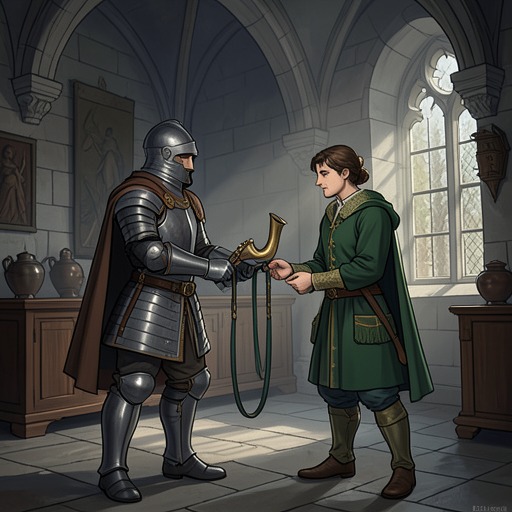
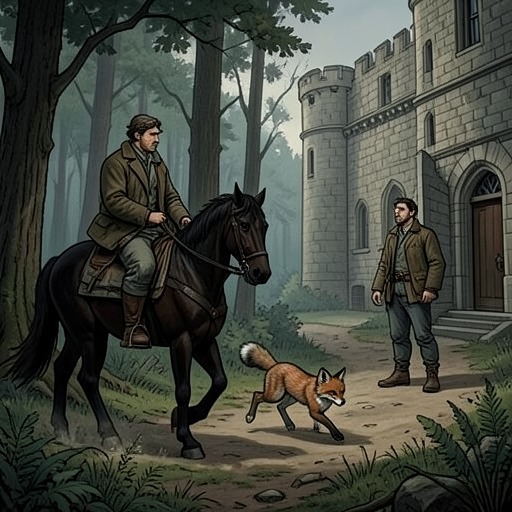
The compact is played out against the sound and movement of the hunt. At daybreak the hunters open the kennel and sound three blasts on their horns before releasing the hounds. Bertilak’s pursuit of deer is described as an organized undertaking: the hunters follow the chase, kill their quarry, and prepare the venison according to the work required of the hunt. These details give the forest winnings a material, visible character. They are not merely claimed; they are tracked, handled, and brought back to the household.
At the castle, meanwhile, Lady Bertilak comes to Sir Gawain’s chamber and greets him as he wakes, teasing him for sleeping so unsuspectingly. Her visit places the other side of the daily arrangement indoors, where what Sir Gawain gains is not a carcass or a share of the hunt but the tokens and advances of a private exchange. The two settings create the game’s governing contrast: Bertilak’s winnings are produced before hunters and servants, while the lady’s gifts and requests confront Sir Gawain in a more intimate space.
The day’s hunt and the chamber encounter therefore run in parallel, but they do not carry the same kind of risk. The host’s quarry can be publicly displayed and passed across according to the wager. Sir Gawain’s conduct with Lady Bertilak must instead meet competing demands of courtesy, restraint, and fidelity to the agreement. The game tests whether the rule of exchange will hold when the day’s most consequential gain is difficult to acknowledge openly.
Gifts, Value, and Concealment
The distinction becomes sharp when Lady Bertilak offers Sir Gawain a ring of worked red gold, with a bright stone set above it. The ring is a tangible and valuable gift, but he does not accept it. Later, the offered object that changes the stakes is the Green Girdle. Lady Bertilak represents its protective property as extraordinary: whoever wears it closely is beyond the reach of a weapon capable of killing him. For a knight bound to meet the Green Knight, the promise of protection gives the girdle a value that exceeds its appearance as a wearable token.
Sir Gawain accepts the girdle. Lady Bertilak asks him to keep it from her lord, and he agrees to conceal it. That promise conflicts directly with the exchange game’s requirement to surrender what he has won. The girdle is not simply a more precious version of the ring: its alleged power makes it a safeguard against the danger awaiting him, while its secrecy makes accepting it a breach of the bargain. The exchange thus sets the open return of ordinary winnings against a private benefit Sir Gawain fears to relinquish.
The contrast also clarifies how the wager works as more than a contest in generosity. Bertilak’s deer is cut up and shown; Sir Gawain is called forward among the people and shown parts of the hunted animals, including their tails and the fat trimmed from their ribs. This public accounting gives the exchange a visible standard. Against it, the concealed Green Girdle is an unreturned gain: its importance lies not only in what it may do, but in the fact that Sir Gawain withholds it from the very compact he has accepted.
Settlement and Revelation
When Bertilak returns from a hunt, he greets Sir Gawain and says that he will now fulfil their agreement. The settlement brings the game’s two tracks together: the lord presents what he has won, while Sir Gawain’s return is judged by what he received during the day. The formal exchange makes his concealment consequential. He has kept the girdle rather than handing over everything gained, so an agreement that had seemed an amiable diversion exposes a failure of complete disclosure.
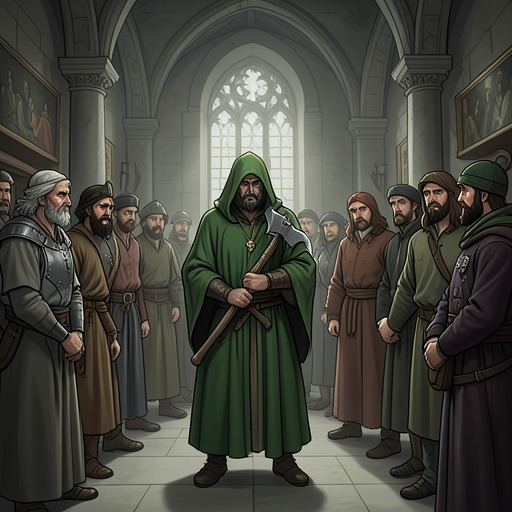
The conclusion also changes the reader’s understanding of the host. Asked to name himself, Bertilak reveals that he is Bertilak of Hautdesert and says that the events have taken place through the power of Morgan le Fay, who lives in his household. The revelation recasts the hospitality, the hunt, and the temptation as parts of an arranged trial. The game has not merely measured whether Sir Gawain can follow a rule in easy circumstances; it has placed a real fear of death against his obligation to keep faith, then made the concealed exception the evidence by which his conduct can be judged.
The wager’s lasting significance lies in this carefully staged disparity between what can be shown and what is hidden. The venison passes through a public ritual of presentation; the Green Girdle remains secret until the larger test is understood. Through that contrast, the exchange game turns a courteous agreement into a measure of Sir Gawain’s honesty under pressure, and the final disclosure reveals that the apparent sporting hospitality was part of a design.